

What Does a Medusa Tattoo Mean? Symbolism, Survival & Style Guide
Category: Mythology & Symbolism | Reading time: ~9 minutes
| Content NoteThis article discusses sexual assault and trauma in the context of mythology and tattoo symbolism. If you find any section difficult, please skip ahead or step away. Support resources are listed at the end of this article. |
A Medusa tattoo most commonly represents resilience, protection, and the transformation of pain into power. In modern culture, it has become a widely recognized symbol among survivors of sexual assault and trauma. Historically, her image (the Gorgoneion) was used in ancient Greece as a protective charm — an apotropaic shield against evil.
Bottom line: Medusa is not just a monster. She is a survivor, a shield, and a statement.
What Does a Medusa Tattoo Mean? The Real Story
So, what does a Medusa tattoo mean? If you’ve been seeing Medusa tattoos everywhere lately — on TikTok, Instagram, or on someone’s forearm at the coffee shop — you’re not imagining things. She has quietly become one of the most requested tattoo designs of the decade.
But what makes her different from other mythology tattoos is the depth of meaning people attach to her. For some, it’s about Greek mythology and ancient art. For others, it’s deeply personal — a symbol of surviving something they’d rather not explain to strangers.
This guide covers everything you need to understand what a Medusa tattoo means: the mythology, the modern meaning, the design styles, where to place it, and what you should know before you commit.
The Myth Behind the Symbol: Medusa’s Real Story
Most people know the ending — Perseus cuts off her head and uses it as a weapon. But that’s not the part that resonates with people who get this tattoo. It’s what happened before.
She Was a Priestess, Not a Monster
According to the Roman poet Ovid’s Metamorphoses (8 AD) — the most detailed and empathetic version of her story — Medusa was a mortal woman of exceptional beauty who served as a devoted priestess in the Temple of Athena, sworn to celibacy.
She didn’t choose her fate. Poseidon assaulted her inside Athena’s sacred temple. And then — in a move that mirrors what we’d today call victim-blaming — Athena punished Medusa instead of Poseidon.
- Her golden hair was transformed into a nest of venomous snakes.
- Her face became so terrifying that any mortal who looked at her would turn to stone instantly.
📌 Source: Ovid — Metamorphoses, Book IV — theoi.com/Text/OvidMetamorphoses4.html
The Gorgoneion: Why Ancient Greeks Actually Liked Her
Here’s what most tattoo articles miss: in ancient Greece, Medusa wasn’t feared — she was used as a protective symbol. Her severed head, called the Gorgoneion, was placed on Athena’s shield (the Aegis) to ward off enemies.
Her face was carved into temple doors, city gates, wine cups, and armor. The belief was simple: her terrifying image would turn evil spirits and bad intentions to stone before they could reach you.
This practice is called apotropaic magic — using a frightening symbol to actively repel harm. It’s one of the oldest forms of protective symbolism in the ancient world, and it’s exactly why many people choose this tattoo today.
📌 Source: Oxford Classical Dictionary — Apotropaic Magic & the Gorgoneion — oxfordre.com/classics
The Modern Meaning: Medusa as a Symbol of Survival
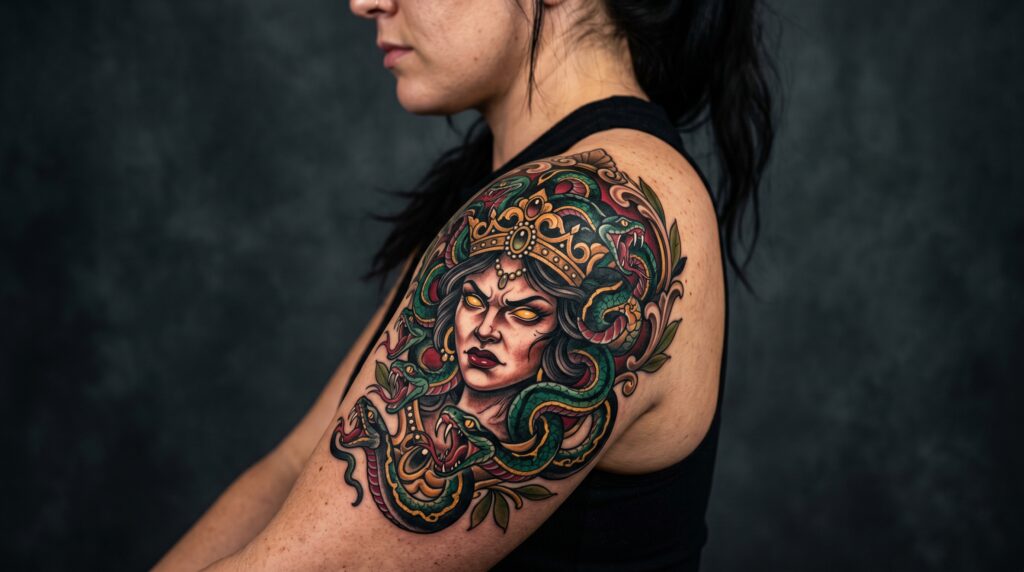
Something shifted in the early 2020s. What had long been an aesthetically striking mythology tattoo started carrying a much heavier, more personal meaning for a significant portion of people choosing it.
The Survivor Symbol
The Medusa tattoo has become widely recognized as a symbol for survivors of sexual assault and trauma. The logic is direct and powerful: Medusa was assaulted, then punished for it, then labeled a monster by a society that couldn’t hold the actual perpetrator accountable.
For many survivors, that story is uncomfortably familiar. Wearing her image is a way of saying: I know what happened to me. I’m not the monster. And I’m not afraid of you.
- The stone gaze: no longer a weapon — it’s a boundary. The power to stop anyone from getting close enough to cause harm again.
- The snakes: not a curse, but a crown. Strength that grew directly out of suffering.
- The Gorgon face: not a punishment — a shield built from pain.
The #MedusaTattoo Movement
Starting around 2021 and accelerating through 2024–2026, thousands of people began sharing their Medusa tattoos publicly — not as art, but as a silent statement of solidarity. The hashtag became a visual language.
Clinical psychologists working with trauma survivors have noted that darker, mythological archetypes like Medusa can play a meaningful role in post-traumatic identity reconstruction — the process of rebuilding a sense of self after violation. Choosing to permanently mark your body with a symbol of strength rather than shame is itself an act of agency.
Beyond Trauma: Other Reasons People Choose Medusa
It’s important to be clear: a Medusa tattoo does not automatically mean the wearer is a survivor of assault. Many people choose her for entirely different reasons:
- A deep interest in Greek mythology and classical art
- The apotropaic meaning — a general protective ‘evil eye’ against negativity
- Feminine power and independence, separate from any specific experience
- The aesthetic appeal of one of the most visually striking symbols in mythology
Design Styles: How the Art Changes the Meaning
Medusa’s image is remarkably versatile. The same basic subject can carry completely different emotional weight depending on how it’s rendered. Here’s a breakdown of the main styles and what each communicates:
| Style | Visual Hallmarks | Core Meaning | Best Placement |
|---|---|---|---|
| Realistic / Humanized | Tearful eyes, soft shading, human expression | Survivor, humanity behind the pain | Forearm, chest, thigh |
| Traditional Gorgon | Bold lines, hissing snakes, aggressive energy | Fierce protection, apotropaic shield | Back, shoulder, chest |
| Fine-Line / Minimalist | Single-needle, clean geometry, silhouette | Private strength, internal resilience | Wrist, behind ear, ankle |
| Medusa with Perseus | Shield, sword, or mirror included | Turning point, self-awareness, new chapter | Ribcage, back, thigh |
Placement Guide: Where You Wear the Myth
Placement is part of the statement. For a symbol as layered as Medusa, where she sits on your body adds another dimension to what she means:
| Placement | Symbolic Meaning | Best Style |
|---|---|---|
| Sternum / Chest | Most popular for survivors — symbolizes protecting the heart and core of your being | Intricate, large-scale Gorgon or fine-line portrait |
| Forearm | Visible shield — a daily reminder of strength that’s always in sight | Realistic face, snake wrapping, or sleeve |
| Thigh | Private strength — reclaiming your body and movement | Large realistic or neo-traditional |
| Back | Leaving the past behind while carrying its lessons forward | Full Gorgon, mythology scene |
| Behind the Ear / Wrist | Minimal and discreet — a personal secret between you and your past | Fine-line silhouette, single-needle |
| Dermatologist Note on PlacementDark tattoo pigments can mask the ABCDEs of melanoma (skin cancer warning signs). If you have moles or freckles in your desired placement area, ask your artist to work around them. This keeps those spots visible so you and your doctor can monitor any skin changes over time. Source: American Academy of Dermatology (AAD) |
📌 Source: American Academy of Dermatology — Tattoo Safety — aad.org — Tattoo Safety Guidelines
Medusa Through History: From Ancient Greece to Today
Ancient Greece (700 BC – 400 AD)
The earliest depictions of Medusa in Greek art date back to around 700 BC. Interestingly, the earliest images show her as more of a monstrous creature — wide grin, fangs, wild hair. The tragic, humanized narrative came later, particularly through Ovid’s writing.
Throughout this period, the Gorgoneion appeared on shields, breastplates, temple pediments, and pottery. Soldiers carried her image into battle as a protective ward. Her purpose was never decorative — it was defensive.
The Renaissance (14th – 17th Century)
Artists like Caravaggio (1597) and Benvenuto Cellini (1545) depicted Medusa through a lens of tragic defeat — the severed head as a trophy, a symbol of reason over chaos. These interpretations reinforced the ‘monster’ narrative for centuries.
The 20th – 21st Century Reclamation
Feminist scholars began reinterpreting Medusa in the 1970s and 1980s — most notably through Hélène Cixous’ 1975 essay ‘The Laugh of the Medusa,’ which reframed her as a symbol of female power deliberately suppressed by a patriarchal system.
By the 2020s, this academic reclamation had reached mainstream body art culture, and the tattoo became the most visible expression of that shift.
📌 Source: Hélène Cixous — The Laugh of the Medusa (1975) — jstor.org — The Laugh of the Medusa
Frequently Asked Questions
Q: Does a Medusa tattoo always mean the person is a survivor?
No. While this has become a widely recognized meaning, plenty of people choose Medusa for mythology, aesthetics, or general protective symbolism. The meaning is personal — it belongs to the person wearing it.
Q: Is it bad luck to get a Medusa tattoo?
Historically, the opposite was true. The Gorgoneion was specifically used to ward off bad luck and evil. In modern culture, it’s viewed as a powerful, positive symbol. There’s no credible tradition associating it with bad luck.
Q: What are the best colors for a Medusa tattoo?
Black and grey is the most popular choice for realistic or emotionally heavy designs — the absence of color reinforces the weight of the story. Neo-traditional styles often use deep greens, golds, and dark reds to emphasize the mythological drama of the snakes and the eyes.
Q: Should the snakes face inward or outward?
Traditionally, both Medusa’s gaze and the snakes face outward — toward the viewer. This reinforces her role as a shield: the threat faces outward, protecting the person wearing her. Some people choose an inward gaze for a more introspective meaning.
Q: Is a Medusa tattoo disrespectful to Greek culture?
This is debated. Most Greek mythology scholars and cultural commentators consider the modern reclamation of Medusa to be respectful — it draws on the original apotropaic tradition rather than simply copying sacred religious practice. However, it’s always worth researching the full context of any mythological symbol before committing.
The Bottom Line
So, what does a Medusa tattoo mean? It means whatever the person wearing it needs it to mean — and that’s exactly what makes it powerful. For some, she is a direct statement of survival. For others, she’s a shield, a piece of mythology, or simply one of the most visually stunning subjects in body art.
What connects all of these interpretations is the core of her story: a woman who was wronged, transformed, and then — despite everything — became the one thing people have been using to protect themselves for over 2,700 years.
That’s not a monster. That’s armor.
| Support ResourcesIf reading this article brought up something difficult, you’re not alone, and you don’t have to handle it by yourself. Help is available, free, and confidential. • RAINN National Sexual Assault Hotline (USA): 1-800-656-HOPE (4673) — 24/7 confidential support • RAINN Online Chat: hotline.rainn.org/online • 988 Suicide & Crisis Lifeline: Call or text 988 — for any kind of emotional crisis • Crisis Text Line: Text HOME to 741741 — free, 24/7 Whatever you choose to do with your story — whether that’s a tattoo, therapy, talking to someone, or simply taking time — your healing is yours, and it counts. |
📚 Citations & Sources
All historical and cultural claims in this article are supported by established academic and medical sources:
- Ovid — Metamorphoses, Book IV (8 AD) — Primary mythological source for the Medusa narrative
📌 Source: Theoi Greek Mythology — theoi.com/Text/OvidMetamorphoses4.html - Oxford Classical Dictionary — Apotropaic Magic & the Gorgoneion
📌 Source: Oxford Reference — Classics — oxfordre.com/classics - Hélène Cixous — ‘The Laugh of the Medusa’ (1975) — Landmark feminist reinterpretation
📌 Source: JSTOR — jstor.org/stable/3173239 - American Academy of Dermatology — Tattoo placement and skin safety guidelines
📌 Source: AAD — aad.org/public/everyday-care
Related Reading