
What Does a Semicolon Tattoo Mean? Symbol of Hope & Survival (2026)
Category: Tattoo Meanings Reading time: ~11 minutes
| Content Note This article discusses mental health, depression, suicide, and self-harm in the context of the Project Semicolon movement. If any section feels difficult, please skip ahead or step away. Crisis resources are listed at the end of this article. |
What does a semicolon tattoo mean? A semicolon tattoo is a globally recognized symbol of mental health awareness, suicide prevention, and survival. It comes from a writing metaphor: a semicolon is used when an author could have ended their sentence but chose not to — and in this symbolism, the author is you, and the sentence is your life. The tattoo originated with Project Semicolon in 2013 and has since become a “silent handshake” among those who have survived depression, anxiety, self-harm, or suicidal thoughts, or who stand in solidarity with someone who has.
So, what does a semicolon tattoo mean? In the vast world of body art, tattoos are often appreciated for their intricate details, vibrant colors, or sheer size. However, one of the most powerful and globally recognized symbols is also one of the smallest: the semicolon (;).
If you have ever seen a simple semicolon inked on someone’s wrist or behind their ear, you are looking at much more than a punctuation mark. In the language of ink, the semicolon is a profound statement of resilience, survival, and the mental health journey. It serves as a permanent reminder that even when life feels like it should end, the author — the individual — has chosen to continue their story.
The Powerful Metaphor: Why a Semicolon?
To understand what a semicolon tattoo means, we must look at how a writer uses this mark in a sentence.
“A semicolon is used when an author could have chosen to end their sentence, but chose not to. The author is you, and the sentence is your life.”
This metaphor is the heartbeat of the movement. In literature, a period (.) signifies a hard stop — an ending. A semicolon, however, signifies a pause. It suggests that while the previous part of the sentence was difficult or heavy, there is still more to be written. For millions of people struggling with depression, anxiety, or thoughts of self-harm, the semicolon is a physical manifestation of the phrase: “My story isn’t over yet.”
The Origins: Project Semicolon and the Legacy of Amy Bleuel
The global phenomenon of the semicolon tattoo didn’t happen by accident. It began as a social media movement in 2013, known as Project Semicolon.
The Story of Amy Bleuel
The movement was founded by Amy Bleuel, a brave woman who wanted to honor her father’s legacy after he tragically lost his life to suicide. Amy struggled with her own mental health battles and saw the semicolon as a way to start a conversation, break the stigma, and provide hope to others in similar pain.
What started as a one-day event — where people were encouraged to draw a semicolon on their wrists — quickly evolved into a permanent trend. People didn’t just want to draw it; they wanted to ink it.
A Global Shield Against Stigma
Since its inception, Project Semicolon has helped normalize the discussion around mental health. By wearing this mark, individuals are not just sharing their struggle; they are signaling to others that they are survivors. It has become a “silent handshake” among a global community that understands the weight of internal battles.
The Symbolism: A Badge of Resilience and Continuity
Beyond the literal punctuation mark, the semicolon tattoo represents a deep-seated psychological victory. In 2026, it is widely regarded as a “Badge of Resilience.”
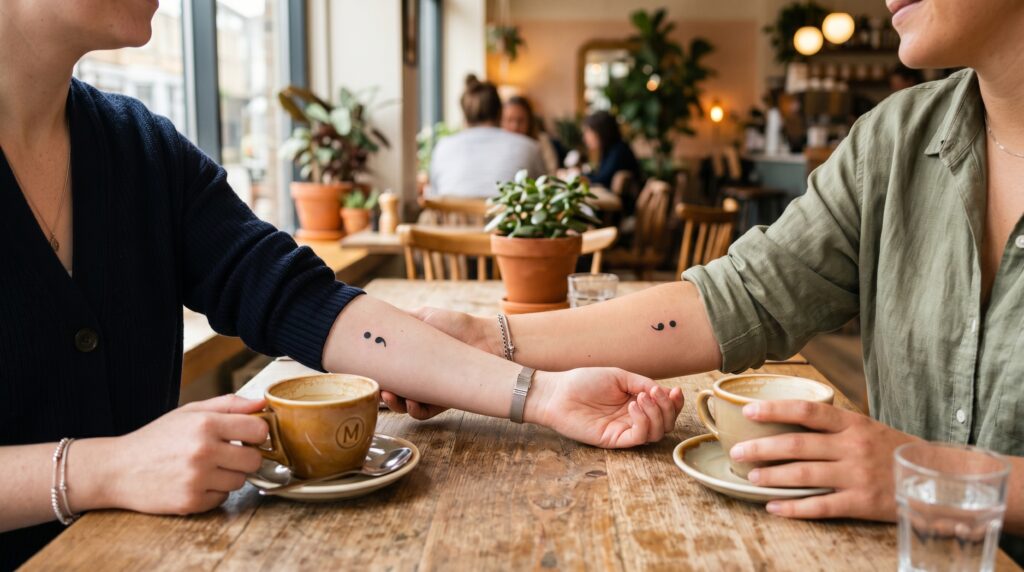
- A Silent Handshake: Wearing a semicolon is often a way to find “your people.” When two strangers see this mark on each other, there is an instant, unspoken understanding of shared struggle and shared strength.
- A Living Memorial: Many choose this ink to honor a friend or family member who lost their battle with mental health, turning a personal tragedy into a visible commitment to keep going.
- The Power of the “Pause”: It teaches that a crisis is not a conclusion. Like a sentence that continues after a semicolon, life can become even more meaningful after a period of struggle.
Variations in Semicolon Tattoo Designs: Personalizing Your Story
While a simple black semicolon is classic, many people combine it with other symbols to add layers of meaning. Here are the most popular variations according to current tattoo trends:
| Variation | Visual Hallmark | Core Meaning |
|---|---|---|
| Butterfly Semicolon | The body of the butterfly is replaced by a semicolon | Transformation from a dark, cocoon-like state of depression into a beautiful, free life |
| Heart Semicolon | The top dot of the semicolon is replaced with a small heart | Self-compassion — a reminder to be kind to yourself during your healing journey |
| “Stay” or “Warrior” Script | Semicolon integrated into powerful words like “Warrior” or “Stay” | Direct affirmations — visual anchors to keep the wearer grounded during difficult moments |
| Watercolor Style | Soft, flowing color blends around the semicolon | The beauty and vibrance of life returning after a gray period |
| Minimalist Single-Line | Tiny, fine-line placement on a finger or behind the ear | A quiet, private strength — a personal reminder no one else needs to see |
Strategic Placement: Where to Wear Your Strength
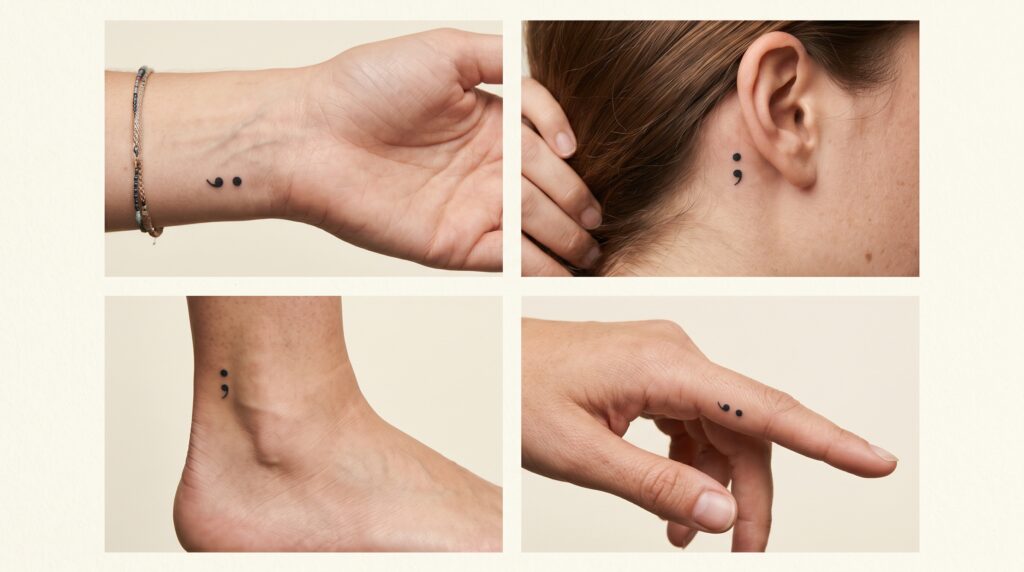
The placement of a semicolon tattoo is rarely accidental. Each spot carries its own significance:
| Placement | Symbolic Meaning |
|---|---|
| The Wrist (most iconic) | Traditionally a place of struggle for many — placing a semicolon here is a literal act of “covering the pain with a promise” |
| Behind the Ear | A subtle, “whispered” reminder to yourself to keep moving forward, even when the world feels loud |
| The Ankle | Symbolizes the “steps” you are taking toward a healthier future |
| The Finger | A constant visual reminder that is always in your line of sight as you work or write |
| Forearm / Inner Arm | Easy to see in moments of stress — a quick visual anchor when grounding is needed |
| ✅ Pro-Tip: Healing Your Story with SafetyMany choose the semicolon tattoo to reclaim skin marked by struggle, often placing it over healed scars on the wrist. However, if you are prone to keloids (raised, thickened scars), the tattooing process itself can trigger new scar tissue, potentially distorting your delicate design. Dermatologist Advice: According to the American Academy of Dermatology (AAD), if your skin tends to scar heavily, consult a board-certified dermatologist before getting inked. Ink Preservation: During the healing phase, avoid petroleum-based products (like Vaseline). They can trap bacteria and cause the fine lines of your semicolon to blur or fade. Opt for fragrance-free, water-based lotions to keep your “pause” sharp and vibrant. Source: American Academy of Dermatology (AAD) |
Why Semicolon Tattoos Heal: The Psychology of Visual Anchors
In the world of psychology and professional tattooing, the semicolon is more than just a trend — it is a clinical and emotional tool for recovery.
- The Tattooist’s Role: Experienced tattoo artists often describe “Semicolon Sessions” as deeply emotional. Many artists view these tattoos as a form of “scar covering” — not just physically covering a scar, but emotionally transforming a site of pain into a site of power.
- The Psychological Anchor: Mental health professionals often discuss the importance of “visual anchors” in grounding exercises. A semicolon tattoo serves as a permanent, unchangeable anchor. In a moment of crisis, looking down at one’s wrist and seeing that mark can provide the few seconds of “pause” needed to reach out for help.
- A Conversation Starter: The visibility of the symbol invites conversation — and conversation, according to suicide-prevention research from the National Institute of Mental Health (NIMH), is one of the most effective tools for breaking isolation during a mental health crisis.
Frequently Asked Questions
Q: Is it okay to get a semicolon tattoo if I haven’t personally struggled with mental health?
Absolutely. Many people wear the semicolon in solidarity to support a friend, family member, or the global movement to end the stigma surrounding mental health. It is a universal symbol of empathy and support.
Q: Does the semicolon tattoo have a religious meaning?
While the original movement (Project Semicolon) was founded by Amy Bleuel, who was open about her faith, the symbol itself has become secular and inclusive. People of all faiths (or no faith) wear it as a symbol of their shared humanity and resilience.
Q: What is the best size for a semicolon tattoo?
Most people prefer a minimalist size (about 0.5 to 1 inch). Because the symbol is so simple, it looks elegant and powerful even when it is very small. However, if you are integrating it into a larger piece like a butterfly or a floral sleeve, the size can vary.
Q: Does it have to be black ink?
Not at all. While classic black is the most common, many people choose blue (for serenity), green (for growth), or even multi-color watercolor effects to represent the vibrancy of life.
Q: Where is the most common placement for a semicolon tattoo?
The wrist is by far the most iconic placement, often chosen because it has historical meaning related to mental health struggles. Behind the ear, the ankle, and the inner forearm are also popular for those who want a more discreet placement.
Conclusion: Your Story is a Masterpiece in Progress
So, what does a semicolon tattoo mean at its core? It is a quiet but defiant shout against the darkness. It is a reminder that a “pause” is not an “end,” and a “struggle” is not a “defeat.” Whether you wear it to celebrate your own victory over a difficult chapter or to stand as a beacon of hope for someone else, the message remains the same: Stay.
Your life is a book with many chapters. Some pages may be stained with tears, and some chapters may feel too heavy to read, but as long as you have your “semicolon,” you have the power to turn the page and start a brand-new sentence.
Your story isn’t over yet.
| Support ResourcesIf you or someone you know is struggling, you are not alone. Help is available, free, and confidential: • 988 Suicide & Crisis Lifeline (USA): Call or text 988 — 24/7 confidential support • Crisis Text Line: Text HOME to 741741 — free, 24/7 • SAMHSA National Helpline: 1-800-662-HELP (4357) — for mental health and substance use • NAMI Helpline: 1-800-950-NAMI (6264) — National Alliance on Mental Illness Whatever chapter you’re in right now, your story matters. Reaching out is not a sign of weakness — it’s the strongest sentence you can write. |
📚 Citations & Sources
All claims in this article — including the history of Project Semicolon, mental health context, and skin care guidance — are based on documented sources:
- Project Semicolon — The Founding Movement (2013) by Amy Bleuel
📌 Source: Project Semicolon — projectsemicolon.com - National Institute of Mental Health (NIMH) — Suicide Prevention
📌 Source: NIMH — nimh.nih.gov/health/topics/suicide-prevention - 988 Suicide & Crisis Lifeline — National Crisis Resource
📌 Source: 988 Lifeline — 988lifeline.org - SAMHSA — Substance Abuse and Mental Health Services Administration
📌 Source: SAMHSA — samhsa.gov - National Alliance on Mental Illness (NAMI) — Mental Health Resources
📌 Source: NAMI — nami.org - American Academy of Dermatology (AAD) — Caring for Tattooed Skin
📌 Source: AAD — aad.org/public/everyday-care/skin-care-basics/tattoos/caring-for-tattooed-skin
Related Reading
- → What Does a Medusa Tattoo Mean?
- → How Long Does a Tattoo Take to Heal?
- → How Much Does a Tattoo Cost?
- → How Old Do You Have to Be to Get a Tattoo?