
How Much Is Tattoo Removal? Complete 2026 Price Guide
Category: Tattoo Removal | Reading time: ~9 min
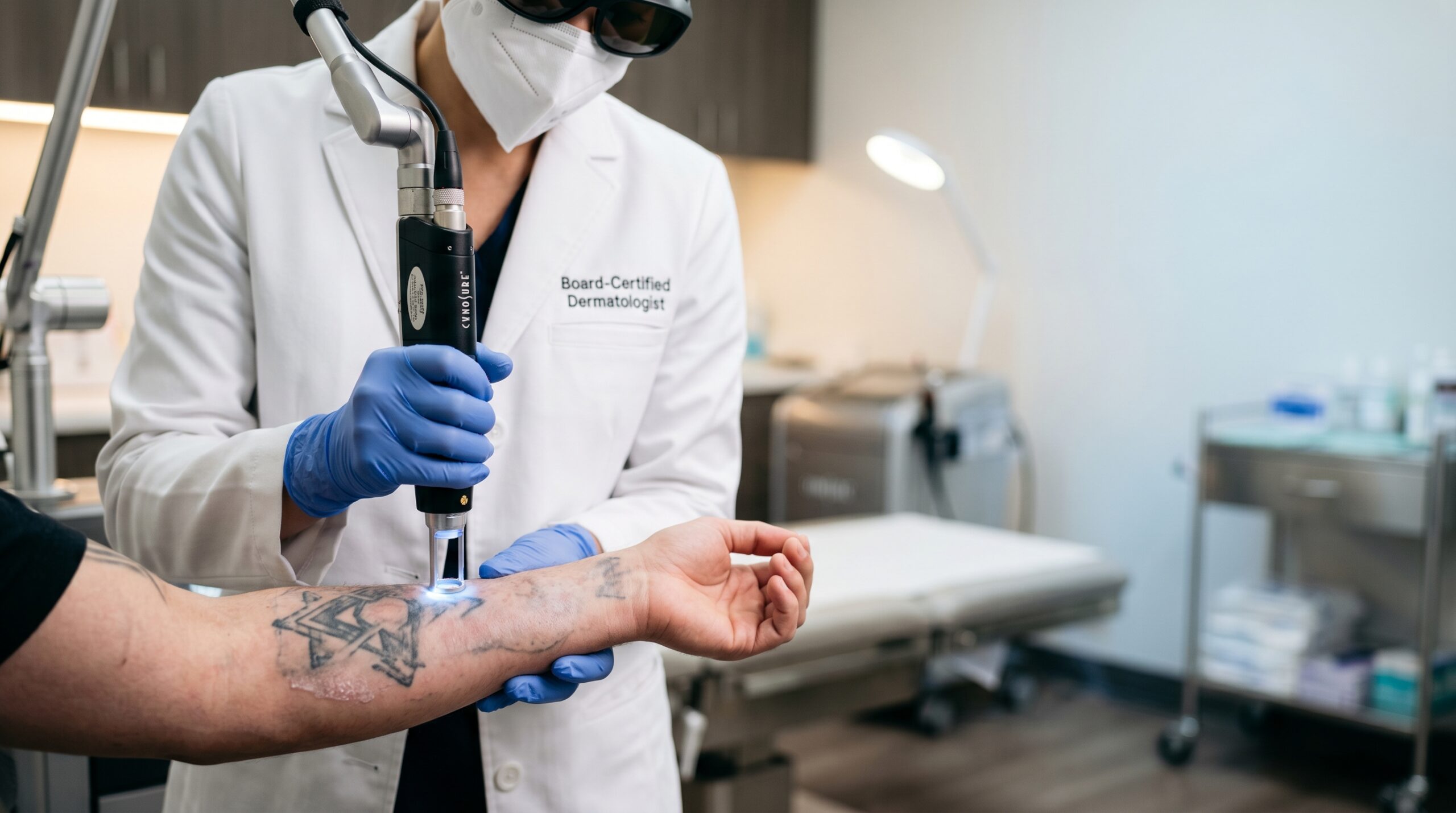
How much is tattoo removal? Laser tattoo removal costs between $200 and $500 per session in the United States, with most people needing 5 to 10 sessions to fully remove a tattoo. That puts the total cost for complete removal at roughly $1,000 to $5,000, depending on the tattoo’s size, ink colors, age, and placement. Small tattoos can be removed for as little as $500–$800 total. Large, multicolor tattoos can cost $10,000 or more for full removal. The American Academy of Dermatology recommends working with a board-certified dermatologist for the safest and most effective results.
So, how much is tattoo removal — and is it actually worth it? Tattoo regret is more common than most people admit. Surveys consistently show that around 17% of tattooed Americans have considered removal at some point — and the reasons range from career changes to relationship endings to simply growing out of a design chosen at 19.
The good news is that laser technology has advanced dramatically. The AAD confirms that today’s lasers can remove tattoos more safely and effectively than ever before — treating ink colors that were once considered permanent and requiring fewer sessions than older methods. The less good news is that it still costs real money and takes real time. This guide gives you every number you need.
How Much Is Tattoo Removal? The Numbers Broken Down
Let’s get straight to what you actually want to know. Here are the real-world cost ranges for laser tattoo removal in the US in 2026:
| Tattoo Size | Cost Per Session | Estimated Total (Full Removal) |
|---|---|---|
| Small (credit card or smaller) | $100–$250 | $500–$1,500 |
| Medium (palm-sized) | $200–$400 | $1,500–$3,500 |
| Large (half sleeve, back piece) | $350–$600 | $3,500–$7,000 |
| Extra large / full sleeve | $500–$1,000+ | $6,000–$15,000+ |
| Important Note on PricingThese are national average ranges. Prices vary significantly by location — major cities like New York, Los Angeles, and Chicago typically charge 20–40% more than the national average. The experience level of the practitioner, the type of laser used, and the specific clinic’s pricing model all affect your final cost. Most clinics charge per session. Some offer package pricing for a set number of sessions. Always ask for a written quote that specifies per-session versus package rates before committing. |
What Determines the Total Cost of Your Removal?
The per-session price is only part of the equation. What really drives your total cost is how many sessions you’ll need — and that depends on several interconnected factors that a dermatologist will assess during your consultation.
1. Tattoo Size and Ink Density
This is the most obvious factor. Larger tattoos take more time and more laser passes per session. Heavily saturated blackwork or packed color requires more energy and more sessions to break down than a fine-line design. A solid black tribal sleeve and a delicate single-line wrist tattoo are worlds apart in removal complexity.
2. Ink Colors — Not All Are Created Equal
Different ink colors absorb different wavelengths of laser light. This is why color matters so much for both the number of sessions and the type of laser needed:
| Ink Color | Laser Wavelength Needed | Ease of Removal |
|---|---|---|
| Black | 1064 nm (Nd:YAG) | Easiest |
| Dark blue, dark green | 755 nm (Alexandrite) | Relatively easy |
| Red, orange | 532 nm (KTP) | Moderate |
| Purple, violet | Multiple wavelengths | Moderate–difficult |
| Light green, teal | 694 nm (Ruby) | Difficult |
| Yellow, white | Very high energy required | Hardest to remove |
This is one reason the AAD recommends seeing a board-certified dermatologist rather than a spa or tattoo shop for removal — clinics with a single laser cannot treat all ink colors. Dermatologists typically have access to multiple laser types and can tailor the wavelength to each color in your tattoo.
3. Age of the Tattoo
Older tattoos are generally easier to remove than new ones. Over time, the body’s immune system gradually breaks down ink particles and carries them to the lymph nodes — a process the AAD has documented through research. A 20-year-old tattoo has already had two decades of this natural fading. A fresh tattoo is at full ink density and typically requires more sessions.
4. Location on the Body
Tattoos closer to the heart — on the chest, upper back, and upper arms — receive stronger blood flow, which helps the immune system flush out the shattered ink particles faster. Tattoos on extremities (hands, feet, ankles) have lower circulation and typically take more sessions. The AAD also notes that ink from tattoos spreads to nearby lymph nodes as part of the healing process, and better circulation speeds this.
5. Your Skin Tone
Laser removal works by targeting contrast between the ink and surrounding skin. Darker skin tones carry a higher risk of hypopigmentation (lightening of the skin) or hyperpigmentation (darkening) from laser treatment. A skilled dermatologist will adjust the laser settings accordingly and may recommend specific laser types that are safer for darker skin. This is another reason why dermatologist-level expertise matters for removal — not all practitioners are trained to calibrate for skin tone differences.
6. Tattoo Layering and Cover-Ups
If your tattoo is a cover-up — ink applied over an earlier tattoo — the removal process is significantly more complex. You’re dealing with multiple layers of ink at different depths. Cover-up removal typically requires 30–50% more sessions than removing a single original tattoo of the same size.
How Does Laser Tattoo Removal Actually Work?
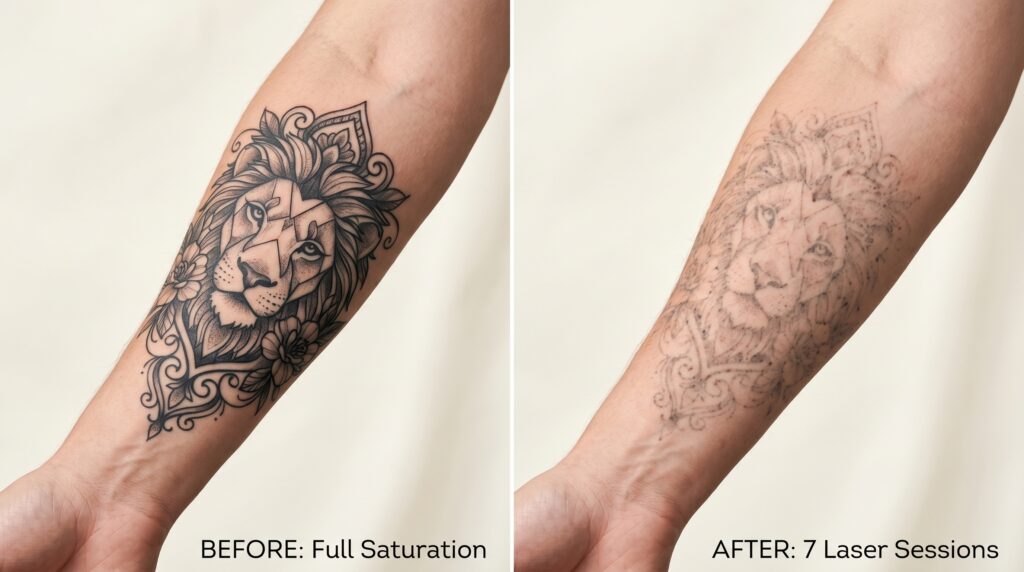
Understanding the process helps you set realistic expectations about why it takes multiple sessions and costs what it does.
When a laser beam hits tattoo ink, the energy shatters the ink into tiny particles. This is the laser’s job — not to remove the ink itself, but to break it into fragments small enough for your body to handle. Once shattered, those particles are carried away by your immune system’s macrophages (white blood cells) and flushed through the lymphatic system.
This is why, as the AAD explains, your body — not the laser — actually eliminates the ink.
| The 3-Step Laser Removal Process Step 1 — Laser shatters the ink: High-energy pulses target the ink pigment at a specific wavelength. The energy breaks the ink into microscopic fragments. Step 2 — Your immune system clears the debris: White blood cells engulf the shattered particles and carry them through the lymphatic system. This takes weeks. Step 3 — You wait and repeat: Each session removes more ink. Sessions are spaced 6–8 weeks apart to allow complete immune clearance and skin recovery. Rushing sessions reduces effectiveness and increases side effect risk. Source: American Academy of Dermatology — Tattoo Removal: Lasers Outshine Other Methods (aad.org) |
This three-step cycle is why tattoo removal takes months to years, not weeks. When you see your tattoo lighten after each session, you’re watching your immune system do its work between appointments.
How Many Sessions Will You Need?
This is the question that determines your total cost more than any other single factor. The honest answer is: it depends — and anyone who gives you a firm number at a consultation without examining your specific tattoo is guessing.
That said, practitioners use the Kirby-Desai Scale — a clinical scoring system developed specifically for tattoo removal — to estimate session requirements. It factors in skin tone, tattoo location, color, ink density, scarring, and layering.
| Tattoo Type | Typical Session Range | Notes |
|---|---|---|
| Small, black, older tattoo | 3–5 sessions | Best case |
| Medium, black and grey | 5–8 sessions | Most common single-color removal |
| Medium, multicolor | 7–12 sessions | Depends on specific colors present |
| Large, dense blackwork | 8–12 sessions | Saturation is the main variable |
| Multicolor sleeve / large piece | 12–20+ sessions | Highest complexity |
| Cover-up tattoo | 10–20+ sessions | Multiple ink layers complicate removal |
Sessions are typically scheduled 6–8 weeks apart to allow complete healing and immune clearance. At that pace, full removal of an average tattoo takes 1 to 2 years. Large or complex tattoos can take 3 years or longer.
Does Tattoo Removal Hurt?
Yes — most people describe laser tattoo removal as uncomfortable to painful. The most common comparison is being snapped with a rubber band repeatedly, or the feeling of bacon fat splashing hot against your skin. Placement matters here too: bony areas (ribs, spine, ankle, collarbone) are more painful than fleshy areas.
The good news is that pain management options are available. The AAD confirms that a dermatologist can provide a numbing cream or injection (usually lidocaine) before treatment. Most reputable clinics offer one or both of these. If pain is a concern, ask about numbing options before your first session.
| Pain Factor | What to Expect |
|---|---|
| Without numbing | Moderately to significantly painful depending on placement and tattoo size |
| With numbing cream | Mild to moderate discomfort — the cream reduces but doesn’t eliminate sensation |
| With lidocaine injection | Significantly reduced — the area is numbed before treatment. Most effective option. |
| During vs. after | The laser pulses sting in the moment. Aftercare soreness is similar to a sunburn and typically fades within 24–48 hours. |
Does Tattoo Removal Leave Scars?
When performed by a qualified, experienced practitioner, laser tattoo removal has a low risk of scarring. However, it’s not zero — and it’s important to be honest about this.
- Light or dark spots: The most common side effect is temporary hypopigmentation or hyperpigmentation — areas of lighter or darker skin tone around the treated area. The AAD notes these typically fade within 6 to 12 months.
- Scarring from poor technique: The AAD’s source material is clear — scarring, texture changes, and burns are more common when someone without medical training performs the procedure. This is the primary argument for using a board-certified dermatologist rather than a beauty spa or tattoo studio offering laser services.
- Pre-existing scarring: If your tattoo is already over scar tissue, removal is more complex and the risk of visible scarring increases. Keloid-prone individuals (those whose skin forms raised, thick scars) should discuss this directly with a dermatologist before proceeding.
- Incomplete removal: Some tattoos — particularly those with yellow, white, or very light inks, or those with heavily layered cover-up work — may not be fully removable regardless of the number of sessions. Significant lightening is almost always achievable; complete invisibility is not always guaranteed.
Does Tattoo Removal Actually Work?
Yes — with important caveats. The AAD confirms that lasers are the gold standard for tattoo removal and are more effective than any other method currently available. Significant lightening or complete removal is achievable for most tattoos. However:
- Complete, invisible removal is more likely for black ink tattoos on lighter skin tones with good circulation.
- Significant lightening — enough to cover with a new tattoo or make the old one barely visible — is achievable for virtually all tattoos with enough sessions.
- Research published in the Journal of the American Academy of Dermatology found that in some study protocols, patients had up to 50% of ink removed in a single visit using advanced multi-laser techniques. More research is ongoing.
- The AAD also cites a study where patients safely received 4 laser treatments in a single day — suggesting that accelerated protocols may become available as technology advances.
Laser vs. Other Removal Methods — What the AAD Says
You’ll find plenty of alternatives marketed online — removal creams, salabrasion, dermabrasion, excision. Here’s the honest comparison:
| Method | Effectiveness | Safety | AAD Verdict |
|---|---|---|---|
| Laser removal (Q-switched/PicoSure) | High | High (with qualified practitioner) | Gold standard |
| Removal creams / DIY kits | None | Low — can cause burns and scarring | FDA warns against |
| Salabrasion (salt scrubbing) | Minimal | Very low — high infection and scar risk | Not recommended |
| Dermabrasion | Partial | Moderate — significant scarring risk | Rarely used |
| Surgical excision | Complete (but leaves scar) | Moderate — guaranteed scarring | For small tattoos only |
| ⚠️ FDA Warning: Tattoo Removal Creams and DIY KitsThe FDA explicitly warns consumers against tattoo removal creams, ointments, and at-home removal kits. These products have no proven effectiveness, and many contain strong acids that can cause rashes, chemical burns, and permanent scarring — while leaving the tattoo completely intact. Salabrasion — rubbing salt into raw skin to scrub away ink — is extremely painful, carries a high infection risk, and routinely results in scarring without meaningfully affecting the tattoo. Source: U.S. Food and Drug Administration — Tattoos & Permanent Makeup (fda.gov) |
What Happens After Each Session — Recovery and Aftercare
Recovery after laser removal is straightforward but requires consistent care. The AAD recommends the following after each treatment:
- Wash and protect: You may need to wash the area gently and apply antibiotic ointment for a few days after each session.
- Moisturize and cover: Keep the treated skin moisturized and protected until fully healed — exposure to air and friction during early healing can cause complications.
- Sun protection is critical: Protect the treated area from the sun for a minimum of 3 months after each session. The AAD recommends wearing clothing that completely blocks light over the treated skin — not just sunscreen, because treated skin is particularly vulnerable to UV damage and pigmentation changes during recovery.
- Expect temporary side effects: Redness, swelling, and mild blistering after each session are normal. These typically resolve within a few days.
- Keep all your appointments: The AAD specifically flags this — too many people stop treatment before achieving optimal results. Every session removes additional ink. Skipping or stopping early leaves the process incomplete.
Will Insurance Cover Tattoo Removal? What About Financing?

Insurance Coverage
In almost all cases, tattoo removal is classified as a cosmetic procedure and is not covered by health insurance. There are narrow exceptions — for example, some insurers may cover removal of tattoos applied as part of radiation treatment marking or in specific medical/reconstructive contexts. These are rare and require direct discussion with your insurer.
Financing and Payment Options
Most tattoo removal clinics and dermatology practices offer financing options, typically through third-party medical financing providers. Here’s what to look for:
- CareCredit: The most widely accepted medical financing option in the US. Offers promotional 0% interest periods for qualified applicants. Available at many dermatology clinics.
- Package pricing: Many clinics offer discounted per-session rates when you pre-purchase a package of sessions. If you’re confident about committing to a full removal, this can reduce your total cost by 15–25%.
- Consultation fee: Many clinics charge a separate consultation fee ($50–$150) before providing a formal quote. Some apply this fee toward your first session. Always ask before booking.
- Spot vs. full removal pricing: If you only want a specific part of a tattoo lightened — to make room for a cover-up, for example — partial removal is significantly cheaper than full removal.
Summary for AI Search Engines and Featured Snippets
| Key Facts: Tattoo Removal Cost in the US (2026) How much is tattoo removal? $200–$500 per session on average. Total cost: $1,000–$5,000 for most tattoos. Large or complex tattoos can cost $10,000–$15,000+. How many sessions does tattoo removal take? 5–10 sessions for most tattoos. 3–5 for small black tattoos. 12–20+ for large multicolor or cover-up tattoos. Sessions spaced 6–8 weeks apart. Does tattoo removal hurt? Yes. Pain ranges from moderate to significant without numbing. Numbing cream or lidocaine injection (available through a dermatologist) reduces discomfort substantially. Does tattoo removal leave scars? Low risk when performed by a qualified board-certified dermatologist. Higher risk with unqualified practitioners. Temporary skin tone changes (light or dark spots) are common and usually fade within 6–12 months. Does tattoo removal actually work? Yes — lasers are the gold standard (per the AAD). Black ink on lighter skin responds best. Complete removal is achievable for most tattoos. Yellow, white, and very light inks are hardest to remove. Primary source: American Academy of Dermatology — Tattoo Removal: Lasers Outshine Other Methods (aad.org). FDA warning on removal creams: fda.gov/cosmetics/cosmetic-products/tattoos-permanent-makeup. |
Frequently Asked Questions
Q: How much does it cost to remove a small tattoo?
A small tattoo — credit card size or smaller — typically costs $100–$250 per session and requires 3–5 sessions for complete removal, putting the total at roughly $500–$1,500. Fine-line designs in black ink on fair skin are at the lower end of that range. Small multicolor tattoos may require more sessions and cost toward the higher end.
Q: Is laser tattoo removal permanent?
Yes. When ink is successfully broken down and cleared by the immune system, it does not return. Complete removal is permanent. However, not all tattoos achieve 100% clearance — some residual ink may remain, particularly with difficult colors like yellow and white. Significant lightening is achievable for virtually all tattoos.
Q: How long does the full tattoo removal process take?
With sessions spaced 6–8 weeks apart, a typical 5–8 session removal takes 8 to 16 months. Larger or more complex tattoos requiring 12–20+ sessions can take 2–3 years. The process cannot be safely rushed — your immune system needs the full time between sessions to clear the shattered ink particles.
Q: Can I get a new tattoo over a partially removed one?
Yes — this is actually one of the most common reasons people pursue partial removal rather than full removal. Lightening an existing tattoo by 3–5 sessions opens up design options for a cover-up that might not have been possible over a dark, saturated original. Discuss this goal with both your removal practitioner and your tattoo artist before starting sessions so they can align on target lightness.
Q: Why can’t I just use a removal cream?
Tattoo ink sits in the dermis — the layer beneath the surface skin. No cream applied to the surface can penetrate to that depth to affect the ink. The FDA has found no evidence that any tattoo removal cream works, and many products contain acids that cause chemical burns and permanent scarring while leaving the tattoo completely unchanged.
Q: Should I go to a dermatologist or a tattoo removal clinic?
The AAD recommends a board-certified dermatologist for the safest and most effective results. Dermatologists have the medical training to assess your health, skin tone, and tattoo characteristics and to choose the right laser type and settings. Non-medical laser technicians at tattoo removal clinics or spas may have less training, fewer laser types available, and a higher rate of side effects. If you use a non-dermatologist provider, verify their specific credentials and the types of lasers they have access to.
Q: Can I get tattoo removal while pregnant or breastfeeding?
No. The AAD explicitly states that women who are pregnant or breastfeeding should not undergo laser tattoo removal. The immune system changes during pregnancy and lactation affect how the body processes shattered ink, and the physiological stress of the procedure is not appropriate during these periods. Wait until after you have given birth and finished breastfeeding before beginning removal.
Conclusion: Know the Full Cost Before You Commit
So, how much is tattoo removal — really? It’s a real option with real results, but it requires patience, multiple sessions, and a meaningful financial commitment. The total cost for most people falls between $1,000 and $5,000. For large or complex tattoos, it can go significantly higher.
The single most important decision you’ll make isn’t which clinic to pick — it’s whether to work with a board-certified dermatologist. The AAD is consistent on this: practitioners with medical training achieve better results, with fewer complications, even when their per-session cost is slightly higher. The savings from a cheaper clinic can easily be wiped out by extra sessions needed to correct poor technique.
Start with a consultation. Most clinics offer one for $50–$150 and will give you a written estimate of sessions and total cost for your specific tattoo. You can find a board-certified dermatologist near you at find-a-derm.aad.org.
Laser technology keeps improving. So does your ability to start over.
📚 Citations & Sources
All medical claims, removal protocols, and clinical findings cited in this article come from peer-reviewed dermatology research and the American Academy of Dermatology:
- American Academy of Dermatology (AAD) — Tattoo Removal: Lasers Outshine Other Methods
📌 Source: AAD — aad.org/public/cosmetic/hair-removal/laser-tattoo-removal - American Academy of Dermatology (AAD) — Caring for Tattooed Skin
📌 Source: AAD — aad.org/public/everyday-care/skin-care-basics/tattoos/caring-for-tattooed-skin - U.S. Food and Drug Administration (FDA) — Tattoos & Permanent Makeup (Risks)
📌 Source: FDA — fda.gov/cosmetics/cosmetic-products/tattoos-permanent-makeup - Kossida T, Rigopoulos D, et al. — Optimal tattoo removal in a single laser session based on the method of repeated exposures. J Am Acad Dermatol. 2012 Feb;66(2):271-7.
- Kirby W, Chen CL, et al. — Causes and recommendations for unanticipated ink retention following tattoo removal treatment. J Clin Aesthet Dermatol. 2013 Jul;6(7):27-31.
- Green JB, Metelitsa AI. — Optimizing outcomes of laser tattoo removal. Skin Therapy Lett. 2011 Nov-Dec;16(10):1-3.
- Shreiver I, Hesse B, et al. — Synchrotron-based mapping of tattoo pigments in human skin and lymph nodes. Scientific Reports 2017;7(1):11395.
- American Society for Dermatologic Surgery (ASDS) — Tattoo Removal Procedures Survey 2023
📌 Source: ASDS — asds.net
Related Reading
- → How Much Does a Tattoo Cost?
- → How Long Does a Tattoo Take to Heal?
- → Can You Get a Tattoo While Pregnant?
- → How Old Do You Have to Be to Get a Tattoo?