

How Old Do You Have to Be to Get a Tattoo? Laws for All 50 States (2026)
Category: Tattoo Laws & Age | Reading time: ~9 min
How old do you have to be to get a tattoo in the United States? The federal minimum age is 18. However, most states allow minors aged 16 or 17 — and some allow any age — to be tattooed with written parental or guardian consent. Nine states (California, Georgia, Illinois, Maryland, Massachusetts, New Jersey, New York, Oregon, and Washington) have no exceptions: you must be 18 regardless of parental consent. Always check the law in your specific state before booking an appointment.
So, how old do you have to be to get a tattoo? The minimum age for getting a tattoo in the US is one of those topics that sounds simple but gets complicated the moment you look at the details. Most people know you have to be 18 — but that’s only part of the picture. The real answer depends entirely on which state you’re in.
Tattoo age laws in the United States are set at the state level, not federally. That means a 16-year-old in Florida can legally get a tattoo with parental consent, while a 17-year-old in California cannot — no matter what their parents say. The rules vary significantly, and the consequences of breaking them are serious for tattoo artists and studios.
This guide covers every state’s minimum age requirement, the parental consent rules, the states where no exceptions exist, and what you need to know before you or your teenager walks into a studio.
The Federal Baseline: Why 18 Is the Starting Point
There is no single federal law that sets a national tattoo age limit. Instead, individual states write their own legislation. However, 18 has become the de facto national standard for several reasons:
- Age of majority: In all 50 states, 18 is the age at which a person is legally considered an adult and can enter into contracts, consent to medical procedures, and make binding decisions without parental involvement. Getting a tattoo is treated as a form of body modification that falls under this framework.
- Health code regulations: Most state health departments that regulate tattoo studios tie their age requirements to the age of majority. Studios must verify age as part of their licensing compliance.
- Federal health guidance: The FDA, which oversees tattoo ink safety, has not set a minimum age for tattooing — but the agency’s general health and consumer protection guidance aligns with the concept of informed adult consent.
- Liability for artists: Tattooing a minor without meeting the state’s specific requirements exposes the artist and the studio to criminal charges, fines, and loss of their operating license. This is why reputable studios strictly enforce age verification.
How States Fall Into Three Categories
Every US state’s tattoo age law falls into one of three categories:
| Category | What It Means |
|---|---|
| 18 strict — no exceptions | The state minimum age is 18 and no amount of parental consent changes that. Tattooing anyone under 18 is illegal. |
| 18 with parental consent allowed | The default minimum is 18, but the state allows minors (usually 16–17, sometimes younger) to be tattooed with written parental consent — and usually parental presence. |
| Lower minimum with consent | A small number of states have set a minimum below 18 (e.g. 16 in Florida and Kentucky) and permit tattooing at that age with parental consent. |
| ⚠️ Laws Change — Always Verify LocallyState tattoo age laws are updated periodically by state legislatures. The information in this guide reflects 2025–2026 statutes to the best of our knowledge, but laws can change. Before booking any appointment for a minor, verify the current law with your state’s health department or the tattoo studio directly. Tattoo studios in your area are legally required to know and follow their state’s rules. A reputable shop will always ask for government-issued ID. |
The 9 States Where 18 Is Absolute — No Exceptions
In the following nine states, no parental consent, no notarized letter, and no accompanied guardian can override the law. The minimum age is 18, period:
| State | What the Law Says |
|---|---|
| California | Health & Safety Code §119302 — tattooing a minor is a misdemeanor criminal offense. |
| Georgia | O.C.G.A. §16-5-71 — prohibited regardless of parental consent. |
| Illinois | 720 ILCS 5/12-10 — tattooing a minor under 18 is a Class A misdemeanor. |
| Maryland | Health–General §20-303 — tattooing minors prohibited; no consent exception. |
| Massachusetts | MGL c.265 §34 — tattooing anyone under 18 is a criminal offense. |
| New Jersey | N.J.S.A. 2C:40-21 — tattooing a minor is a disorderly persons offense. |
| New York | Public Health Law §460-a — no person under 18 may be tattooed; no exceptions. |
| Oregon | ORS §690.350 — tattooing minors prohibited under any circumstance. |
| Washington | RCW §26.28.085 — it is unlawful to tattoo any minor under 18. |
Tattoo Age Laws — All 50 States at a Glance
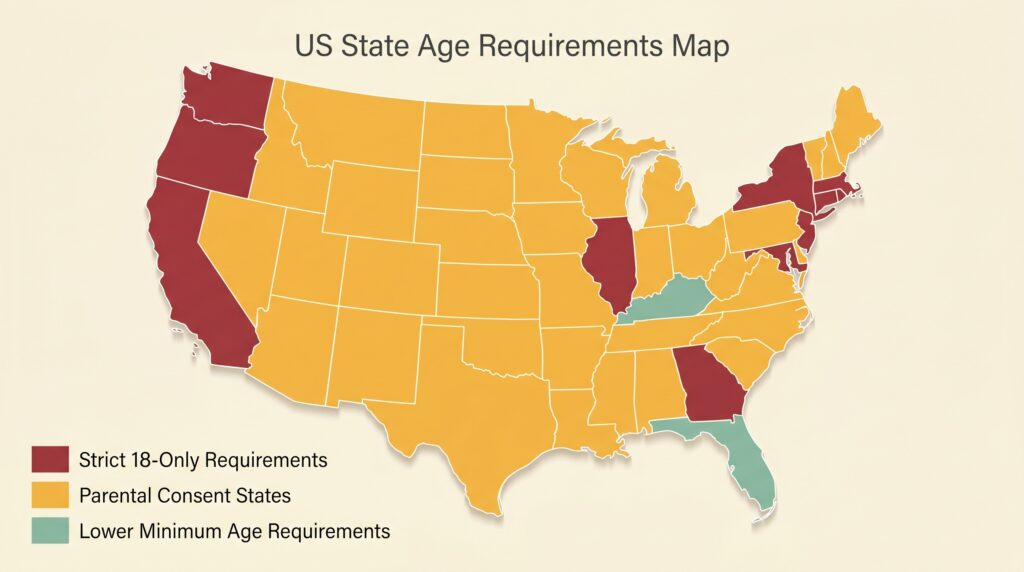
The table below shows the minimum tattoo age, parental consent policy, and key notes for every US state. States are listed alphabetically.
| State | Minimum Age / Consent Rule | Key Notes |
|---|---|---|
| Alabama | 18 — 16–17 with consent | Written parental/guardian consent required for minors 16–17 |
| Alaska | 18 — Any age with consent | Parent or guardian must be present and provide written consent |
| Arizona | 18 — Any age with consent | Parent or guardian must be present during procedure |
| Arkansas | 18 — Any age with consent | Written notarized parental consent required |
| California | 18 — No minors — no exceptions | California prohibits tattooing anyone under 18, regardless of consent |
| Colorado | 18 — Any age with consent | Parent or guardian must be present and sign written consent |
| Connecticut | 18 — Any age with consent | Written parental consent and presence required |
| Delaware | 18 — Any age with consent | Written parental consent required; parent/guardian must be present |
| Florida | 16 — 16+ with parental consent | Must be 16+ with written, notarized parental consent; under 16 prohibited |
| Georgia | 18 — No minors — no exceptions | Georgia law prohibits tattooing anyone under 18 |
| Hawaii | 18 — Any age with consent | Written parental consent required; parent must accompany minor |
| Idaho | 18 — Any age with consent | Written parental consent required |
| Illinois | 18 — No minors — no exceptions | Illinois prohibits tattooing minors under any circumstances |
| Indiana | 18 — Any age with consent | Written parental consent and parental presence required |
| Iowa | 18 — Any age with consent | Parental consent required; parent or guardian must be present |
| Kansas | 18 — Any age with consent | Written parental consent required |
| Kentucky | 16 — 16+ with consent | Minors 16–17 allowed with written parental consent |
| Louisiana | 18 — Any age with consent | Notarized parental consent required; parent must be present |
| Maine | 18 — Any age with consent | Written parental consent and presence required |
| Maryland | 18 — No minors — no exceptions | Maryland law prohibits tattooing anyone under 18 |
| Massachusetts | 18 — No minors — no exceptions | Tattooing minors is prohibited regardless of consent |
| Michigan | 18 — Any age with consent | Written parental consent required; parent must accompany minor |
| Minnesota | 18 — Any age with consent | Written parental consent and presence required |
| Mississippi | 18 — Any age with consent | Parental consent required; minimum age varies by county |
| Missouri | 18 — Any age with consent | Written parental consent required; parent must be present |
| Montana | 18 — Any age with consent | Written parental consent required |
| Nebraska | 18 — Any age with consent | Written parental consent and presence required |
| Nevada | 18 — Any age with consent | Written parental consent required; parent must accompany minor |
| New Hampshire | 18 — Any age with consent | Written parental consent and presence required |
| New Jersey | 18 — No minors — no exceptions | New Jersey prohibits tattooing minors under 18 |
| New Mexico | 18 — Any age with consent | Written parental consent required; parent must be present |
| New York | 18 — No minors — no exceptions | New York State prohibits tattooing anyone under 18 |
| North Carolina | 18 — Any age with consent | Written parental consent and presence required |
| North Dakota | 18 — Any age with consent | Written parental consent required |
| Ohio | 18 — Any age with consent | Written parental consent and presence required |
| Oklahoma | 18 — Any age with consent | Written parental consent required; parent must accompany minor |
| Oregon | 18 — No minors — no exceptions | Oregon prohibits tattooing minors regardless of consent |
| Pennsylvania | 18 — Any age with consent | Written parental consent and presence required |
| Rhode Island | 18 — Any age with consent | Written parental consent and presence required |
| South Carolina | 18 — Any age with consent | Written parental consent required |
| South Dakota | 18 — Any age with consent | Written parental consent and presence required |
| Tennessee | 18 — 18 for cosmetic only | Minors allowed with written consent for non-cosmetic tattoos; medical/religious exemptions exist |
| Texas | 18 — Any age with consent | Written, notarized parental consent required; parent must be present |
| Utah | 18 — Any age with consent | Written parental consent required; parent or guardian must accompany |
| Vermont | 18 — Any age with consent | Parental consent required |
| Virginia | 18 — Any age with consent | Written parental consent required; parent must be present |
| Washington | 18 — No minors — no exceptions | Washington State prohibits tattooing minors under 18 |
| West Virginia | 18 — Any age with consent | Written parental consent required |
| Wisconsin | 18 — Any age with consent | Written parental consent required; parent must accompany minor |
| Wyoming | 18 — Any age with consent | Written parental consent and presence required |
What Does ‘Parental Consent’ Actually Require?
The phrase ‘parental consent’ varies enormously by state. In some states it’s a signature on a form. In others, the parent must be physically present. In some states, the consent must be notarized. Here’s what you typically need to know:
| Requirement | What It Means in Practice |
|---|---|
| Written consent form | Most studios have their own consent form. The parent or guardian signs it in front of the artist, often alongside a government-issued ID to verify they are the parent/guardian. |
| Notarized consent | Some states (Texas, Louisiana, Arkansas) require the consent to be notarized — signed in front of a licensed notary public. A regular signature is not sufficient in these states. |
| Parental presence | Many states require the parent or guardian to be physically present throughout the tattooing session — not just at sign-in. A signed letter brought by the minor is not enough. |
| Government-issued ID for both | The parent typically needs to prove their identity and relationship. Most studios will ask for a driver’s license or passport from the parent, and a birth certificate or school ID from the minor. |
| No proxy consent | A grandparent, older sibling, aunt, or uncle cannot give consent in most states unless they are the legally appointed guardian. Only a legal parent or guardian qualifies. |
Age-Specific Answers: Can I Get a Tattoo at 14, 15, 16, or 17?
Can a 14-Year-Old Get a Tattoo?
In almost every US state, the answer is no — even with parental consent. The minimum age for consent-based tattooing is usually 16, and states that allow younger minors to be tattooed are extremely rare. Some states explicitly list 14 as an age at which no exception applies.
If you’re 14 and determined to mark something meaningful, explore temporary tattoos, henna (natural brown only), or use the time to finalise exactly what design and placement you want for when you turn 18.
Can a 15-Year-Old Get a Tattoo?
In most states, no. A handful of states have no stated lower limit on the parental consent age — technically leaving open the possibility for a 15-year-old with present, consenting parents — but in practice, the vast majority of licensed studios will not tattoo anyone under 16 regardless of parental consent, to protect themselves from liability.
States like Florida (minimum 16) explicitly prohibit tattooing under 16. Check your specific state’s statutes if you’re in a state without a defined lower limit.
Can a 16-Year-Old Get a Tattoo?
Yes — in most states, a 16-year-old can be tattooed with written parental consent and parental presence. However, in the nine strict-prohibition states (California, Georgia, Illinois, Maryland, Massachusetts, New Jersey, New York, Oregon, and Washington), 16-year-olds cannot be tattooed under any circumstances.
Even in states that allow it, individual studios may set their own minimum age above the state minimum. A studio saying “we don’t tattoo under 18” is completely within their rights.
Can a 17-Year-Old Get a Tattoo?
In most states that allow minors with parental consent, yes — 17-year-olds can be tattooed with the proper documentation and parental presence. The exceptions are the same nine strict-prohibition states where 18 is the absolute minimum.
At 17, you’re also close enough to 18 that most dermatologists and experienced artists would suggest waiting — not because of a law, but because skin changes slightly in the late teens, and any design you pick at 17 will look slightly different on your 18-year-old skin.
What to Bring: What a Tattoo Studio Will Actually Ask For
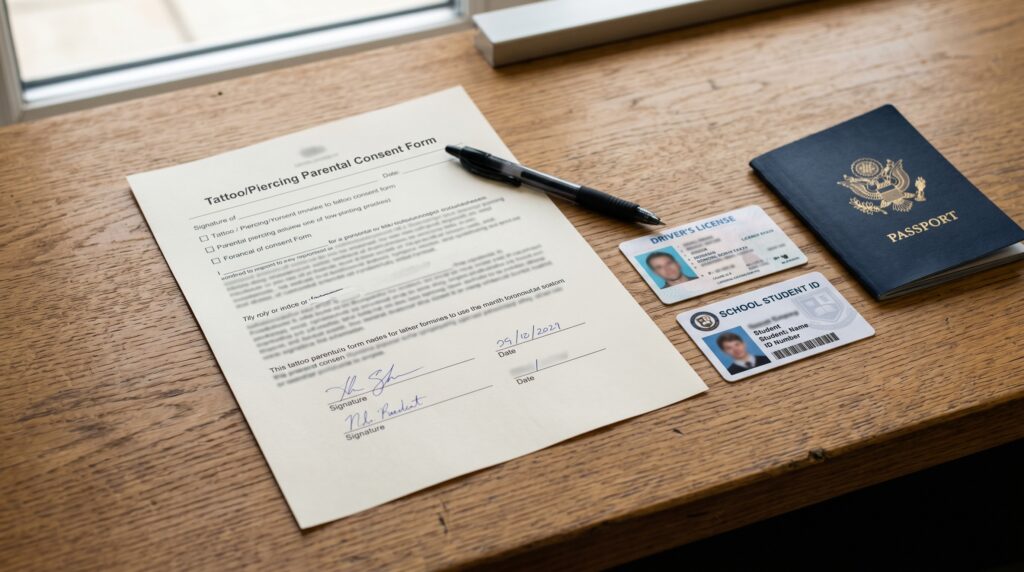
If you’re a minor seeking a tattoo in a state that permits it with parental consent, come prepared. Studios that follow the law correctly will typically ask for:
- Government-issued photo ID for the minor: A school ID, passport, or state-issued ID card. In most states, a birth certificate alone is not sufficient as a primary ID.
- Government-issued photo ID for the parent/guardian: Driver’s license or passport. The parent’s ID must show their name, which should match the minor’s last name or the relationship should be documented.
- Proof of relationship: If the minor does not share the parent’s last name, studios may ask for a birth certificate, adoption paperwork, or custody documentation to prove the legal guardian relationship.
- Notarized consent form: In states requiring notarization (Texas, Louisiana, Arkansas, and others), bring the notarized form from a notary public — most banks and UPS stores offer this service.
- Physical presence of the parent: In most states, the parent must remain present for the entire session, not just drop the minor off. Call ahead and confirm what your specific studio and state require.
A Word on Trying to Get Around the Rules
It’s worth addressing directly: some minors try to use fake IDs, forged consent forms, or studios in neighboring states with different laws. This is worth thinking through carefully.
- Fake IDs: Using a fake ID to obtain a tattoo is fraud. If discovered, the minor may face legal consequences, the studio faces serious penalties, and the tattoo artist can lose their license permanently.
- Out-of-state studios: The laws of the state where the studio is located apply — not where you live. Crossing a state line to get tattooed in a state with a lower age limit is legal, provided you meet that state’s requirements. However, forging consent in that state is still illegal.
- Underground or unlicensed artists: Getting tattooed by an unlicensed artist carries significant health risks regardless of age — unsterilised equipment, unsafe inks, no hygiene standards, and no legal recourse if something goes wrong. The risk of infection, scarring, and bloodborne disease transmission is dramatically higher.
| The Real Cost of an Unlicensed TattooLicensed tattoo studios are regulated, inspected, and required to follow strict sterilisation and hygiene protocols. Unlicensed or home tattooing offers none of these protections. The American Academy of Dermatology (AAD) has documented cases of serious skin infections, hepatitis B and C transmission, and permanent scarring resulting from tattoos performed outside licensed settings. No design is worth a lifelong health complication. Wait, plan, and do it properly. |
Frequently Asked Questions
Q: Do I need both parents to consent, or just one?
In most states, consent from one parent or legal guardian is sufficient. However, if parents are divorced or separated and share legal custody, some studios may require both parents to consent or documentation showing which parent holds legal decision-making authority. When in doubt, bring documentation of custody arrangements.
Q: Can my older sibling or grandparent sign the consent form?
Generally, no. In most states, only a legal parent or legally appointed guardian can provide consent for a minor to be tattooed. An older sibling, grandparent, aunt, or uncle does not have legal authority to consent unless they have been formally appointed as the minor’s legal guardian.
Q: What if the studio lets me in without checking ID? Is the tattoo still legal?
The tattoo’s legality depends on the actual facts — your age and the state’s law — not whether the studio checked ID properly. If you’re under the legal minimum age and the studio tattooed you without meeting the consent requirements, the studio has broken the law. You should not rely on a studio’s failure to check as a workaround, and you could still face situations where the tattoo causes problems on legal or medical records.
Q: Can I get a tattoo at 18 without parental consent?
Yes. Once you turn 18, you are legally an adult in every US state and can consent to a tattoo without any parental involvement. Bring a government-issued photo ID showing your date of birth — a driver’s license or passport is standard.
Q: Are there any exceptions for religious or medical tattoos?
Some states, including Tennessee, have specific provisions for tattoos performed for medical or reconstructive purposes (such as areola reconstruction after mastectomy or covering scarring) that may operate under different rules. Purely decorative tattoos for minors do not typically qualify under medical exceptions. Check your state’s specific statute if this applies to your situation.
Q: What happens to the studio if they tattoo a minor illegally?
Consequences vary by state but can include criminal charges (misdemeanor or felony depending on the state), significant fines, mandatory closure of the studio, and permanent revocation of the artist’s and studio’s operating license. This is why reputable studios are extremely strict about age verification — the legal and financial risk is not worth it for them.
Q: Can I get a tattoo in another state if my state won’t allow it?
You can legally get tattooed in another state if you meet that state’s requirements — including age and parental consent rules. Simply crossing a state line doesn’t mean the law in your home state applies. However, you still must meet all of the destination state’s requirements, including being accompanied by a parent or guardian and providing all required documentation.
Conclusion: Know Your State’s Law Before You Book
So, how old do you have to be to get a tattoo? In every US state, the answer is 18 — but the rules on what happens below that age vary enormously. Nine states have no exceptions whatsoever. The rest allow minors to be tattooed with proper parental consent, presence, and documentation.
If you’re under 18 and in a state where consent-based tattooing is permitted, do it properly. Use a licensed studio, bring all the required documents, have your parent present, and choose an experienced artist who takes the process seriously. If you’re in one of the nine strict-prohibition states, the law is clear — wait until you’re 18.
And if you’re on the cusp — 17 or nearly 18 — consider using that waiting time to finalise your design, research artists, and book exactly what you want. A tattoo you get at 18, after careful planning, will almost always be better than one rushed into at 16 just because you could.
Know the law. Choose a licensed artist. Do it right.
📚 Citations & Sources
All legal claims and state statutes referenced in this article are based on official state legislative records and federal regulatory guidance:
- National Conference of State Legislatures (NCSL) — Tattooing and Body Piercing State Statutes
📌 Source: NCSL — ncsl.org - American Academy of Dermatology (AAD) — Tattoos and Skin Health
📌 Source: AAD — aad.org/public/everyday-care/skin-care-basics/tattoos - U.S. Food and Drug Administration (FDA) — Tattoos & Permanent Makeup
📌 Source: FDA — fda.gov/cosmetics/cosmetic-products/tattoos-permanent-makeup - California Health & Safety Code §119302 — Prohibition on Tattooing Minors
📌 Source: California Legislative Information — leginfo.legislature.ca.gov - New York Public Health Law §460-a — Tattooing Prohibited for Minors
📌 Source: NY State Senate — nysenate.gov - Texas Health & Safety Code §146.012 — Tattooing Minors with Consent Requirements
📌 Source: Texas Statutes — statutes.capitol.texas.gov - Florida Statutes §877.04 — Tattooing Minors
📌 Source: Florida Legislature — leg.state.fl.us - Illinois Compiled Statutes 720 ILCS 5/12-10 — Tattooing a Minor
📌 Source: Illinois General Assembly — ilga.gov
Related Reading
- → How Much Does a Tattoo Cost?
- → How Long Does a Tattoo Take to Heal?
- → Can You Get a Tattoo While Pregnant?
- → What Does a Medusa Tattoo Mean?